Unilateral Moyamoya Disease in an Adolescent Female of Non-Asian Descent: A Case Report
DOI:
https://doi.org/10.3941/jrcr.5942Abstract
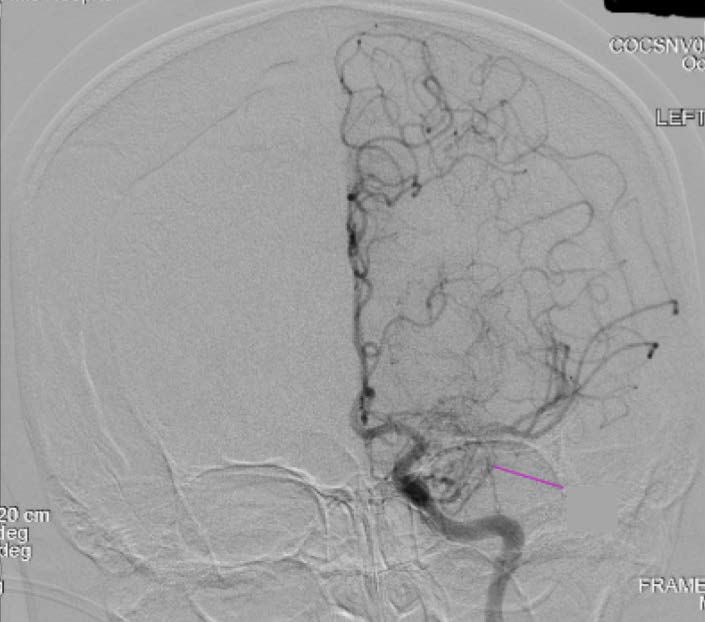
Moyamoya disease (MMD) is an idiopathic occlusive cerebrovascular disease that affects the internal carotid artery, middle cerebral artery or anterior cerebral artery forming a smoke-like collection of blood vessels seen on digital subtraction angiography or magnetic resonance imaging/angiography (MRI/MRA). MMD most frequently occurs in East Asian populations and often leads to headaches, seizures, transient ischemic attacks or strokes. The cause of MMD has yet to be fully explained, but several studies have shown genetics play a factor in the development of MMD. The characteristic “puff of smoke” of MMD is most easily visualized with direct angiography and can be treated surgically with direct or indirect revascularization techniques. This article presents a unique case of moyamoya disease in a Hispanic pediatric patient involving the left middle cerebral artery who was treated with an indirect revascularization technique, encephaloduroarteriosynangiosis.
Downloads
Published
Issue
Section
License
Copyright (c) 2026 Journal of Radiology Case Reports

This work is licensed under a Creative Commons Attribution-NonCommercial-NoDerivatives 4.0 International License.
The publisher holds the copyright to the published articles and contents. However, the articles in this journal are open-access articles distributed under the terms of the Creative Commons Attribution-NonCommercial-NoDerivs 4.0 License, which permits reproduction and distribution, provided the original work is properly cited. The publisher and author have the right to use the text, images and other multimedia contents from the submitted work for further usage in affiliated programs. Commercial use and derivative works are not permitted, unless explicitly allowed by the publisher.