Brass Knuckle Sign: A Collective Appearance of Peribronchial Cuffing
DOI:
https://doi.org/10.3941/jrcr.5852Abstract
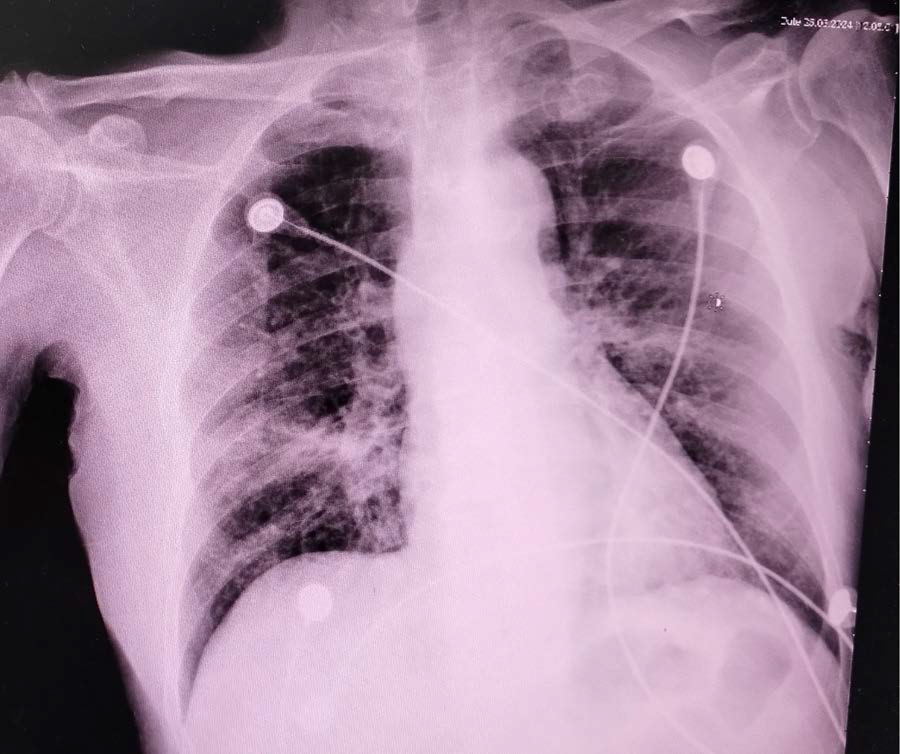
Background: Peribronchial cuffing is a common finding on chest radiography, referring to an increased density of the bronchial walls. This finding is detected when pathologies targeting the bronchial wall cause increased thickness or affect the adjacent vascular bundle. Etiologies often vary from infectious to noninfectious. Different appearances of peribronchial cuffing have been reported, such as donut sign and tram track. Although sometimes its subtlety could hinder its detection and cause further delays in management. This report highlights a new and distinctive radiological appearance of peribronchial cuffing and therefore allows for early recognition. Its visual value, when put into the proper clinical context, allows for earlier narrowing of differential diagnosis and prompt management.
Case presentation: A case of a 58-year-old male, medically and surgically free, who is an ex-smoker. He presented with acute exacerbation of his chronic productive cough, chest tightness, and exertional dyspnea. He was initially suspected to have cardiogenic pulmonary edema, with initial plain chest radiography showing subtle appearances of peribronchial cuffing and airspace opacities. However, after reconsideration of the clinical context supported by physical examination, laboratory findings, and later high-resolution chest CT. It was revealed that he has a significant underlying chronic inflammatory airway disease with infectious exacerbation. The patient was treated with a focus on optimizing airway management and ultimately improved. Revisiting his initial chest radiography, a unique variant of peribronchial cuffing was discovered.
Conclusion: The brass knuckle sign is a new variant of peribronchial cuffing describing an easily distinctive radiological collection of adjacent of thickened airways.
Downloads
Published
Issue
Section
License
Copyright (c) 2025 Journal of Radiology Case Reports

This work is licensed under a Creative Commons Attribution-NonCommercial-NoDerivatives 4.0 International License.
The publisher holds the copyright to the published articles and contents. However, the articles in this journal are open-access articles distributed under the terms of the Creative Commons Attribution-NonCommercial-NoDerivs 4.0 License, which permits reproduction and distribution, provided the original work is properly cited. The publisher and author have the right to use the text, images and other multimedia contents from the submitted work for further usage in affiliated programs. Commercial use and derivative works are not permitted, unless explicitly allowed by the publisher.