Malignant Transformation of an Osteochondroma into a Chondrosarcoma in the Skull Base: A Rare Case Report
DOI:
https://doi.org/10.3941/jrcr.5609Abstract
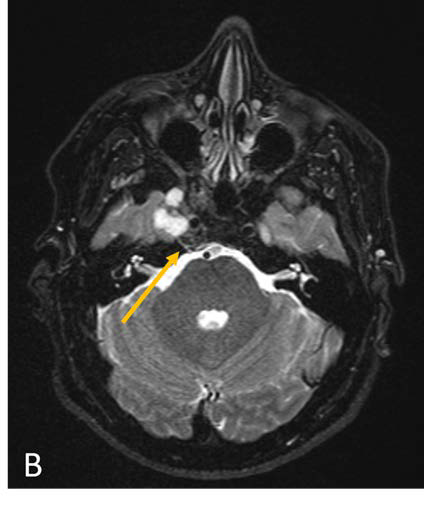
Osteochondromas are benign tumors of skeletal bones that are not commonly seen in the skull. Primary chondrosarcomas of the skull base, on the other hand, are more frequently seen and tend to arise from the sphenoethmoidal regions and petroclival synchondrosis. Chondrosarcoma can also develop secondarily from malignant transformation. However, only one other known reported case of malignant transformation of an osteochondroma into a chondrosarcoma of the skull base has been described in the literature. We present the case of a 29 year old male who presented with right periorbital pain and was found to have an extra-axial lobulated skull base mass with classical features of chondrosarcoma; which ended up being concordant with pathology. However, the petroclival synchondrosis was found to remain intact and not involving the lesion, thus precluding a primary chondrosarcoma that would typically arise from the synchondrosis. Instead, an osseous protrusion arising off the body of the right sphenoid bone was found originating from the lesion, and thus felt to represent a malignant transformation of a primary osteochondroma of the skull base into a chondrosarcoma.
Downloads
Published
Issue
Section
License
Copyright (c) 2026 Journal of Radiology Case Reports

This work is licensed under a Creative Commons Attribution-NonCommercial-NoDerivatives 4.0 International License.
The publisher holds the copyright to the published articles and contents. However, the articles in this journal are open-access articles distributed under the terms of the Creative Commons Attribution-NonCommercial-NoDerivs 4.0 License, which permits reproduction and distribution, provided the original work is properly cited. The publisher and author have the right to use the text, images and other multimedia contents from the submitted work for further usage in affiliated programs. Commercial use and derivative works are not permitted, unless explicitly allowed by the publisher.